Jack-and-Bore Versus Directional Drilling
A rail crossing is not the place to choose an installation method by habit. The wrong choice can create settlement risk, missed grade, stalled production, or a casing that cannot accept the carrier pipe. In the decision between jack-and-bore versus directional drilling, the better method is the one that fits the crossing geometry, ground conditions, utility specifications, and owner requirements - not the one with the lowest initial price.
Both methods install utilities without opening the full surface. Both can protect traffic, pavement, waterways, and developed corridors from the disruption of open-cut work. But they work differently, carry different constraints, and solve different construction problems.
Jack-and-Bore Versus Directional Drilling: The Core Difference
Jack-and-bore installs a steel casing by hydraulic jacking from a launch pit to a receiving pit. As the casing advances, crews excavate material from inside the pipe using an auger or boring head. The casing becomes the structural envelope for the crossing. A carrier line, conduit bundle, or other product pipe is then installed within it, typically on spacers and with end seals as required.
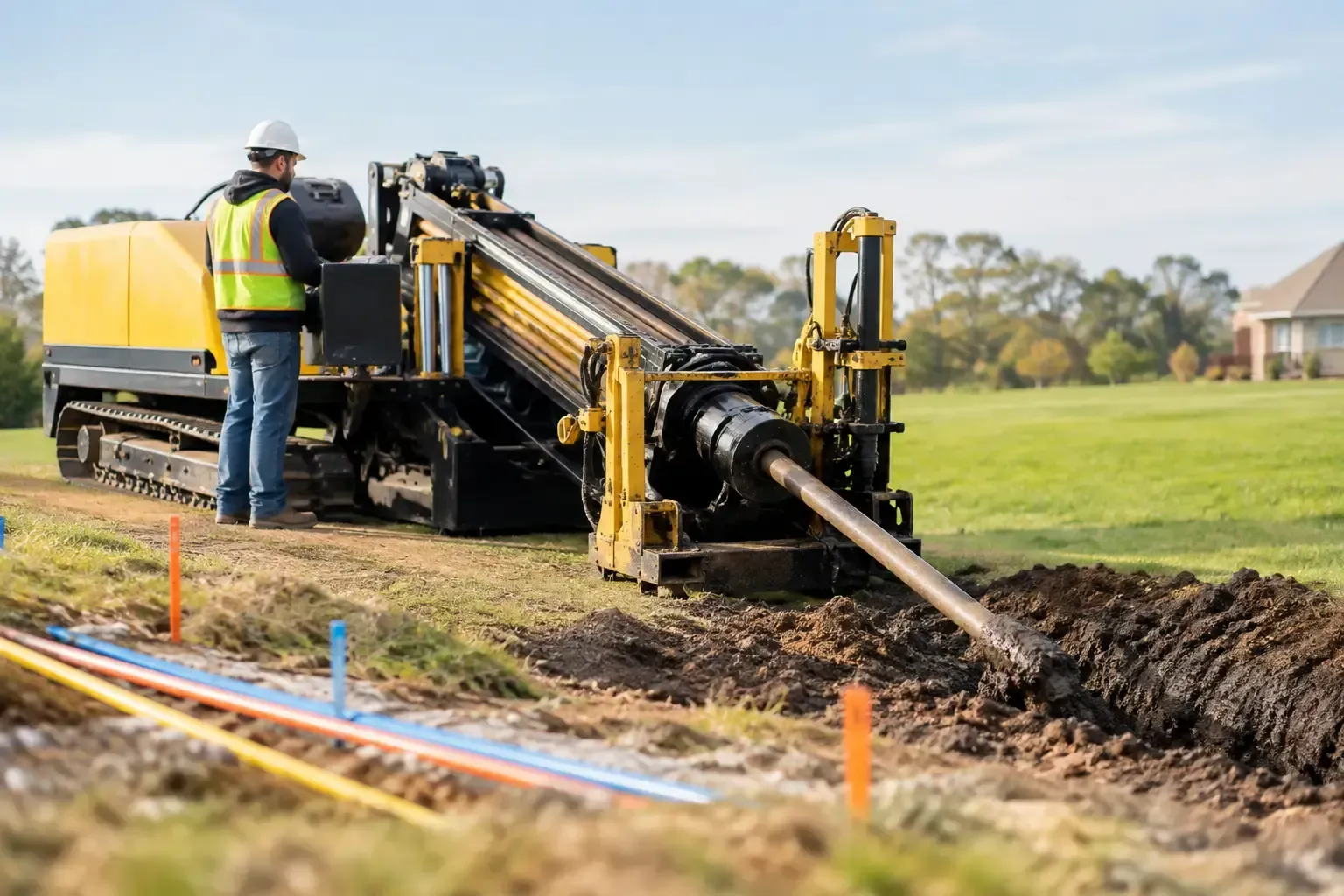
Horizontal directional drilling, or HDD, drills a guided pilot bore along a designed path. The bore is then enlarged through staged reaming, and the product pipe or conduit is pulled back through the completed hole. HDD generally installs the product pipe directly, although a casing can be incorporated in certain designs when project conditions call for it.
That distinction drives the rest of the decision. Jack-and-bore is fundamentally a casing installation method with a relatively straight alignment. HDD is a steerable trenchless method built around controlled path design, depth, and curved geometry.
When Jack-and-Bore Is the Better Fit
Jack-and-bore is often specified for railroad, highway, and other crossings where the owner requires a steel casing. The casing provides a defined protective barrier between the carrier pipe and the crossing above. For certain gas, water, sewer, and pressure-pipe applications, that requirement is written directly into the owner standard or permit condition.
It is also a strong choice for short, straight crossings with enough room to build working pits. A typical setup needs a launch pit sized for the jacking frame, pipe sections, spoil handling, and safe crew access. The receiving side needs room for breakthrough, recovery, and final connection work. If the right-of-way allows that footprint, the method can provide a direct and durable installation.
Ground conditions matter. Jack-and-bore performs best where soil can be excavated through the casing without repeated face collapse, obstruction lockup, or excessive groundwater inflow. Competent geotechnical information helps establish whether the proposed casing diameter, wall thickness, jacking force, and excavation approach are realistic.
The method has limitations. It does not make broad changes in direction after the bore begins. Grade control is critical, especially for gravity systems, but the alignment must be designed as a straight shot with only limited correction capability. Cobble, boulders, buried debris, hard rock, and unstable saturated soils can complicate or stop the advance. Those conditions need to be addressed before the jacking pit is excavated.
Where Directional Drilling Has the Advantage
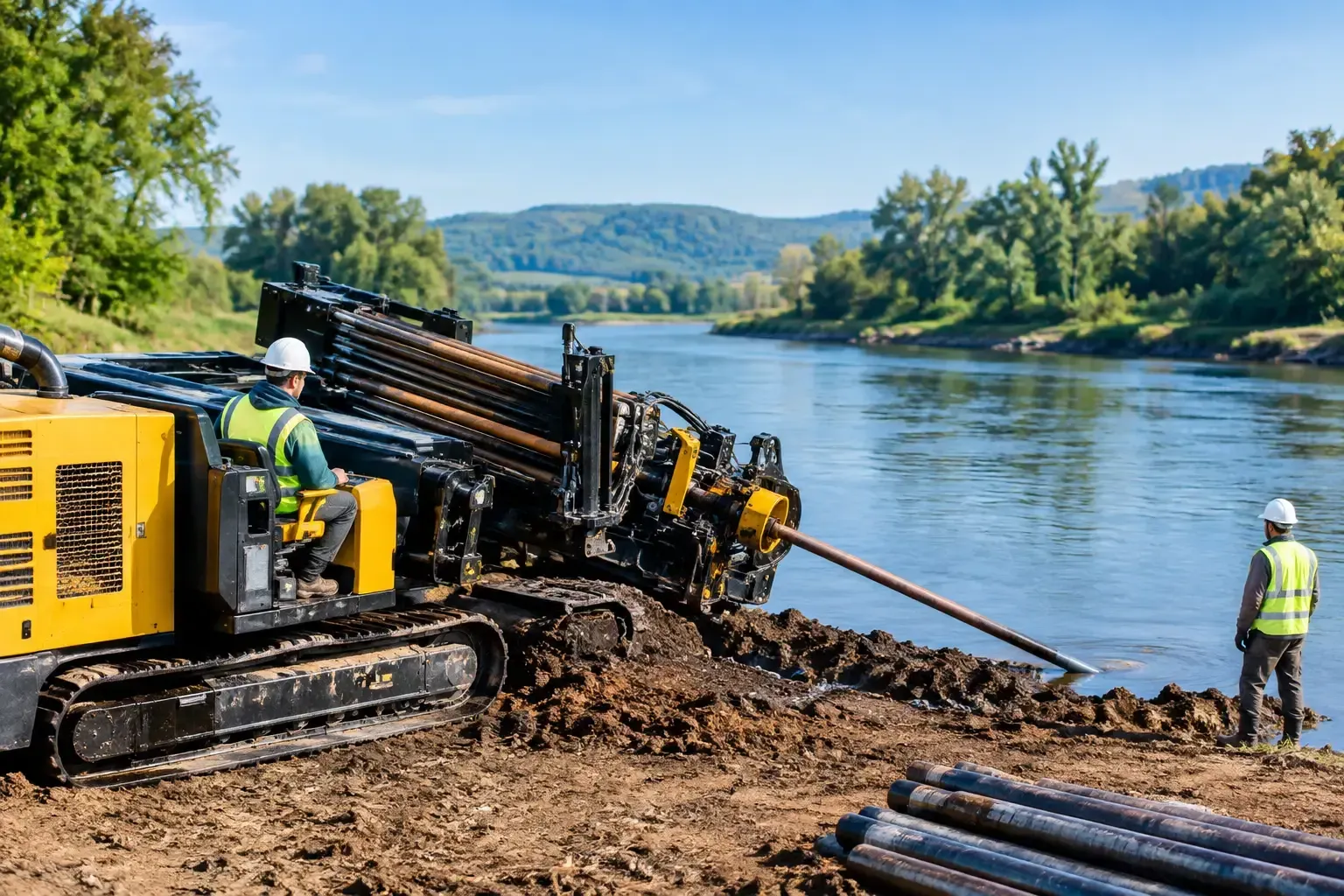
Directional drilling earns its place when the crossing needs geometry that a straight casing bore cannot provide. A properly designed HDD profile can enter and exit from locations that avoid congested pavement, wetlands, structures, existing utilities, or restricted work zones. It can pass beneath a river, highway, or dense urban corridor while maintaining planned depth and separation.
That steering capability is the main advantage. The pilot bore is tracked and adjusted as it progresses, allowing the drill team to follow a designed horizontal and vertical path. This makes HDD particularly effective for long crossings, curved alignments, and installations where the launch and exit points cannot sit directly opposite each other.
HDD can also reduce the need for large, deep pits. There is still substantial site work: drill-rig setup, mud management, pipe-string layout, utility locating, access control, and restoration all require room. But a project may avoid the full excavation footprint needed for a jacking operation.
The trade-off is that HDD depends heavily on subsurface planning and drilling-fluid control. The bore path must be designed around existing infrastructure, required cover, allowable bend radius, geotechnical conditions, and pullback loads. Drilling fluid supports the bore, carries cuttings, cools tooling, and helps manage friction. In sensitive areas, the fluid program and monitoring plan must address the possibility of an inadvertent return at the surface or into a water body.
HDD is not automatically the right answer for every difficult crossing. Highly variable rock, large cobble, uncharted obstructions, or formations that will not maintain a stable bore can raise risk significantly. A specialist should evaluate whether the formation supports a guided bore and whether the product pipe can safely tolerate the planned pull forces and bending stresses.
Start With the Owner Standard, Then the Ground
The first question is not which method is faster. It is whether the crossing authority mandates a method, casing type, depth, or design standard. Railroad and DOT requirements, municipal specifications, pipeline owner rules, and environmental permit conditions can narrow the options before a contractor mobilizes.
If a steel casing is mandatory, jack-and-bore may be the most direct path. If a casing is preferred but not required, HDD with an appropriately engineered installation may offer better constructability. If the product must hold a precise gravity grade, the selection requires additional scrutiny. Neither method should be assumed capable of meeting a tight elevation tolerance without a project-specific plan.
Once the governing requirements are clear, geotechnical review becomes the deciding technical input. Soil borings should be evaluated for strength, grain size, groundwater, rock conditions, obstructions, and transition zones. A boring log is not a guarantee of what the crew will encounter, but it is the basis for selecting tooling, casing approach, drilling-fluid properties, reamer sequence, and contingency planning.
Compare the Job, Not Just the Method
Project teams should weigh several practical conditions before committing to jack-and-bore or HDD:
- Alignment and length: Straight, shorter crossings often favor jack-and-bore. Longer or curved profiles generally favor HDD.
- Casing requirement: If an owner requires a steel casing, jack-and-bore is frequently the baseline solution.
- Available workspace: Jack-and-bore needs launch and receiving pits. HDD needs rig access, fluid containment, and enough area to stage the product pipe.
- Ground and groundwater: Stable boreable soil may suit either method. Difficult rock, cobble, unstable sands, or high groundwater require a detailed constructability review.
- Product pipe limits: HDD pullback places tensile load and bending stress on the installed pipe. Jack-and-bore requires a carrier-pipe installation plan inside the casing.
Cost belongs in the discussion, but it should be considered as total crossing risk. A lower unit price can disappear quickly if the selected method needs repeated redesign, excessive dewatering, an unplanned rescue pit, traffic-control extensions, or a failed bore recovery. The best bid is the one supported by a credible means-and-methods plan.
Planning Controls the Outcome
Trenchless work is often described as low-impact. That is true at the surface only when planning is disciplined. Utility records must be verified in the field. Potholing, survey control, right-of-way limits, permit conditions, and environmental protections need to be settled before equipment arrives.
For jack-and-bore, planning means validating pit locations, shoring requirements, jacking capacity, casing specifications, spoil removal, and carrier-pipe installation details. For HDD, it means building a bore profile, confirming bend radius and separation, selecting tooling and drilling-fluid systems, calculating pull loads, and preparing a fluid-monitoring and response plan.
United HDD reviews these details in-house because difficult crossings do not leave room to outsource the thinking. The field crew needs a plan that accounts for the actual corridor, actual product, and actual ground - not a generic method statement copied from a prior job.
Make the Method Earn Its Place
A casing crossing under a railroad may call for jack-and-bore because the owner standard and straight geometry demand it. A deep fiber route beneath a river or divided highway may call for HDD because controlled curvature and minimal disturbance matter more. Some projects need both methods on different segments of the same utility route.
Bring the bore length, pipe or casing diameter, proposed alignment, utility data, geotechnical information, and schedule constraints to the estimating review early. A clear constructability decision before mobilization is far less expensive than solving for one after the crossing is underway.